Ivy Removal
Whether ivy Invokes images of autumn on the west coast of America, a quiet cottage in a rural idyll or dense thickets engulfing trees in winter, ivy is engrained within the minds of many people. From the cool, dark evergreen of the English ivy to the vivid autumnal colours of the Boston ivy and Virginia creeper, ivy has many differing forms.
English ivy or Hedera helix, found within Araliaceae or the ginseng family, is widespread and is the only evergreen vine native to the UK. Hedera helix can vary in form and shape with two main types within the UK. One of these is the subspecies Hibernica that does not climb and spreads over the ground, the other is the subspecies helix that is found climbing on trees in dense woodland. English ivy varies greatly in its leaf colour and shape but is usually 3-5 lobed, dark- light green and waxy or leathery.
English Ivy
English Ivy provokes mixed to negative views in many people owing to its vigorous growth and potential damage it can cause to building structures. English ivy is not a parasite and supports itself through its own root system, they are not harmful to healthy trees contrary to the popular myth. However, an excess of ivy can indicate poor tree health through a broken canopy that allows extra light for the ivy to grow.
Ivy can cover cracks, breaks and damage in the tree canopy whilst the extra weight can cause weak trees to break or fall at a faster rate. On the other hand, Ivy is useful within a horticultural setting as it is highly tolerant of shade and grows quickly. This makes it a suitable climber for north facing walls and can provide a green backdrop for showy perennials and mixed borders.
There are many cultivars of ivy, varying from the curled leaf ‘Parsely Crested’ to the numerous variegated forms that make ivy a versatile plant in a horticultural setting. Ivy can also be used in container planting as a trailing plant or quickly trained up pergolas and archways.
The dense foliage and branches provide valuable nesting space for many birds and bats whilst the nectar and pollen rich flowers provide autumn food for insects. The berries provide food for the newly hatched birds in the spring making Hedera helix a super wildlife friendly plant. Useful for wildlife, birds enjoy nesting within its dense foliage. The flowers provided early season nectar and pollen for insects and nutritious berries for birds throughout the winter. It can be pruned into shape anytime of the year due to its sturdiness as a plant.
Boston Ivy
Boston Ivy or Parthenocissus tricuspidata is a climbing vine found in Vitaceae or the grape family. Native to East China and Japan, Boston ivy is not a true ivy and is more closely related to the edible grape than it is to English ivy. Tricuspidata gives an indication to its main identifying features with a meaning of ‘with three cuspids’ large 3 lobed palmate leaves that turn vivid autumnal reds.
Ivy Removal
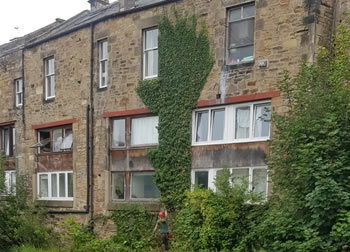
Although Ivy does not damage trees, it can damage buildings. This is due to its method of climbing; aerial roots. The aerial roots climb by penetrating the rough mortar contain a natural glue-like substance.
When removing ivy from walls and buildings, although the bulk can be easily removed, small tendrils will remain which break off from the main plant easily.
For full restoration of your wall after ivy removal, we would recommend power washing to remove the small tendrils, which may lead to re-pointing or patching harling by a builder. This complete removal can be costly, so Edinburgh Tree Surgeons would recommend pruning your ivy on an annual basis if you like the aesthetic on your building.